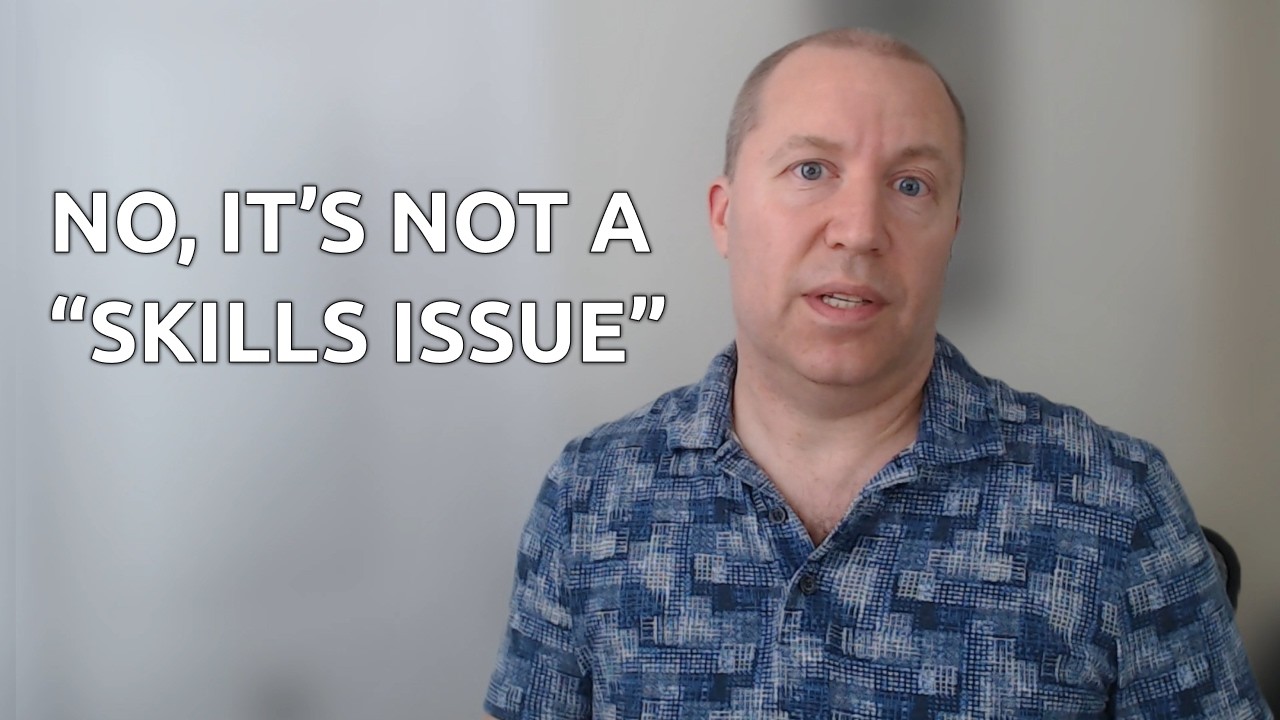
people are lying about agentic coding
Lars Faye argues the industry is sending contradictory signals about agentic coding: one camp says coding is solved and you can be vague with prompts, while anyone who gets bad results is told it's a skill issue. His counterpoint is that the elaborate specs, verification loops, and pipelines needed to make agents work well are themselves proof that deep domain expertise still matters — which contradicts the 'coding is solved' claim. He positions himself as a delegator rather than a full agentic workflow adopter, still reading and writing code because that's how he figures out what to build.
- The 'coding is solved' narrative claims models handle ambiguous requests, search the codebase, consult docs, and commit changes with little developer involvement — and he admits he's had isolated experiences like that.
- When developers report poor results, the standard responses are 'skill issue,' spend more tokens, stop reading the code, wrong model, wrong pipeline.
- His central argument: building the robust architecture, detailed specifications, and verification loops that make agents work requires enormous domain expertise and architectural judgment, so the work hasn't been eliminated, just moved.
- The 'software factory' promise looks like a mirage because software involves innumerable decisions whether you're hand-coding or designing an automation pipeline.
- The dismissive 'you're holding it wrong' reflex feels like gaslighting because the reality of agentic workflows is more nuanced than the hype allows.
- Not enough time has passed to know whether people who've stopped reading their code entirely will be fine long-term, so he's deliberately apprehensive about going that far.
- He frames his goal as doing better rather than going faster, and wants to become more of a domain expert, not trade expertise for speed.
- He cites Addy Osmani — recently joined Anthropic after ~15 years at Google — as someone who embraces AI coding but advocates staying close to the work in small chunks, since expertise comes from friction with the code.
- He expects neither fully autonomous dark software factories nor a bubble pop returning everyone to hand-coding; he's been typing less for years via autocomplete, snippets, and generators, and sees AI as a continuation of that.
This is the core argument: the setup required to make agents work well is itself proof that domain expertise hasn't been eliminated.
I'm here to convince you today that this is in fact not a skill issue. You need a really robust kind of architecture and pipeline configured if you want to get really good results out of these models. And to me that is very different than 'coding is solved.'
He offers a concrete alternative posture to full agentic workflows, plus the reason he keeps typing code — writing types and functions is how he figures out what to build.
I like to look at these tools as a delegation layer that kind of intersects at every part of the stack... I like to call it my ship's computer that I can just kind of call up anytime I want, assign something, and then I go back to work.
I'm not really interested in going faster. I'm interested in doing better.
Me typing out code is the process by which I'm figuring out what we should even be doing.
Just integrate them at whatever level brings more joy to your work.