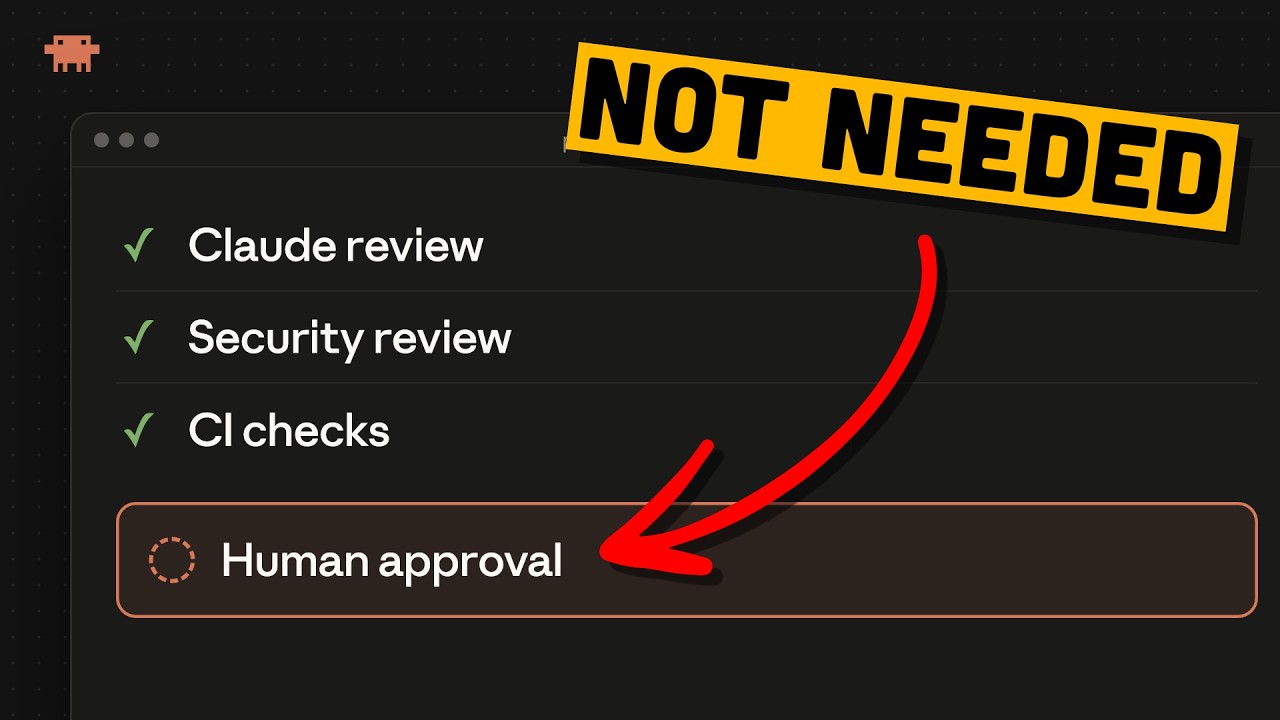
Anthropic says Claude now writes ~90% of Claude Code's own code, so they've shifted from "did a human read this?" to layered automated checks plus risk-tiered human review. The flow stacks self-checks, multi-agent bug review with voting, a security pass, CI, and a classifier that decides whether 0, 1, or 2 humans must approve. They keep the reviewer honest with daily evals built from real incident bugs, and cap review rounds after agent-vs-agent loops ran a PR through 50+ cycles. The video closes by poking at the headline stats: a 40% drop in revert rate alongside doubled PR volume still means roughly 20% more reverts overall.
- Anthropic's main monorepo went from ~2,500 changes a day in May to over 30,000 on its busiest September day, and Claude Code creator Boris was shipping 20–30 PRs a day back in March.
- The target is that most PRs merge with at most one human involved — possibly the author — with the hard constraint that less human review must not increase reverts or production incidents.
- Review works like Swiss cheese layers: self-verification in the engineer's Claude session, a sub-agent diff review, a multi-agent bug review where agents vote before a comment is posted, a security-focused pass, then standard CI and a PR template covering testing and rollback.
- Recurring reviewer complaints get fixed at the system level — a lint rule or a Claude.md line for real mistakes, and a review.md written by code owners describing what failure actually looks like for false positives.
- A classifier agent assigns each PR a risk tier: low-risk (docs, feature-flagged) needs no human, medium needs one, highest-risk paths need two, with a second agent double-checking the call.
- The reviewer is evaluated daily against real bugs from past incidents, confirmed by the engineers who own the code; any prompt or model change must score higher on the eval to be kept.
- Noise is tracked separately because flagging everything would game the eval, and noise hurts more with agent authors — one PR hit 50+ review rounds overnight, with ~59% of flags on code present since the first review.
- Capping re-reviews at three rounds and only re-checking new changes lifted single-round pass rates from 65% to 78% and cut PRs needing five or more rounds from 9% to 1.5%.
A concrete failure mode of agent-to-agent review, plus the specific fix and the numbers showing it worked.
One PR went through over 50 rounds of review overnight before that author stepped in and stopped it. And when they looked at what the reviewer actually kept flagging, about 59% of it was code that had been there since the very first review.
The one moment that pushes back on Anthropic's headline stat and adds the cost caveat of $15–$25 per review.
If you exactly double your PRs while your revert rate drops by 40%, you still end up with about 20% more reverts overall. So it's a great result per PR, but doesn't necessarily mean that fewer things are breaking.
Instead of asking, did a human read this code, they started to ask, what could actually go wrong with this change?
A good review.md says what failure actually looks like in that part of the code.
You land it, you own it — AI saves the time in coding, but 100% of the responsibility should still remain on you.