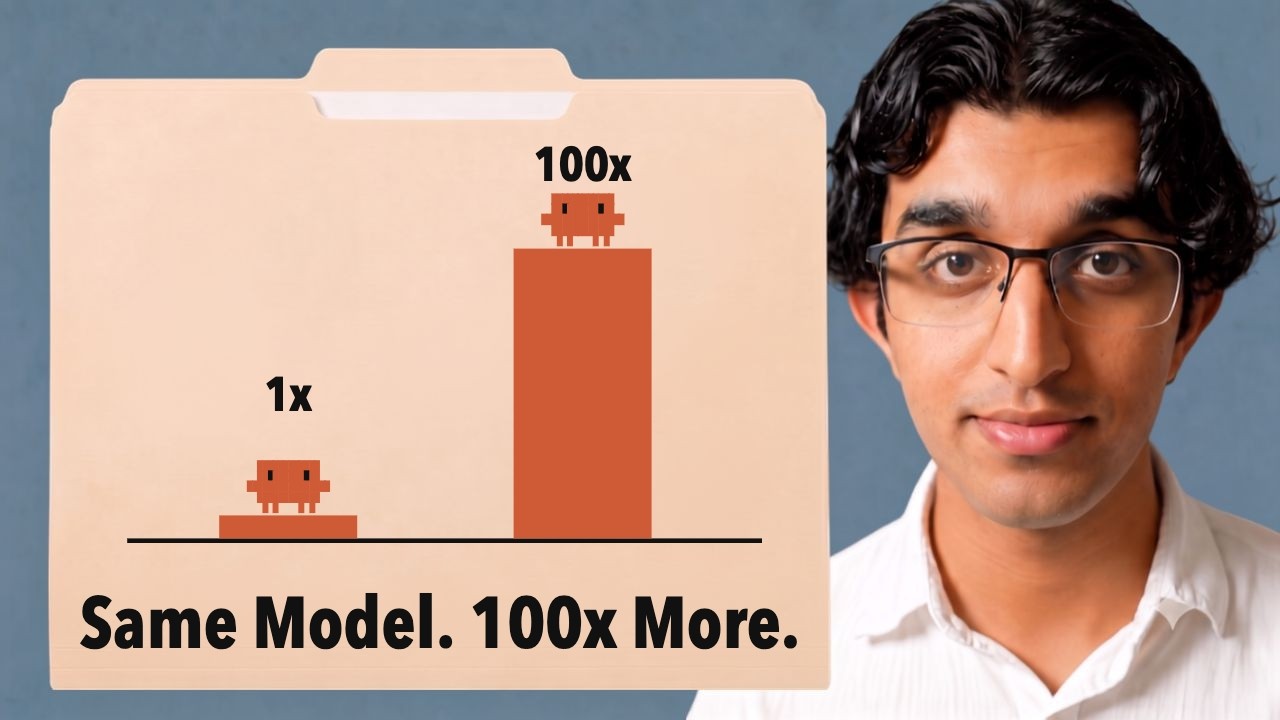
Ray Amjad walks through Felix's Anthropic essay "How to Be More Ambitious," which splits ambition with AI agents into four types: speed, altitude, depth, and range. He skips speed as the thing everyone already does, and spends the video showing concrete Claude Code and Slack-agent setups for the other three: prompting for outcomes instead of tasks, insisting the model use the actual tools an expert would use, and borrowing solutions from unrelated professions. The through-line is that the bottleneck is no longer the model but the ambition of the prompt and the tooling/access you give the agent.
- Altitude means giving the agent the outcome rather than the task — "every page loads in under 200ms for real users" instead of "add an index to the orders query" — and then asking what the goal beyond that goal is.
- Raising altitude only works if the agent has the tools and environments to act; he asks Claude up front what access it needs (Sentry, real Windows/Mac/Linux machines, its own budget-capped AWS account) and lets it ping him when it needs more.
- He replaced himself as the "meat proxy" in support: an agent watches support tickets and Sentry, matches tickets to crashes, tries to reproduce on a real machine, asks the user clarifying questions if it can't, then fixes, merges and replies — including a ticket that arrived in Japanese.
- Instead of dashboards, he has a weekly Slack agent generate ten questions he should be asking about customer satisfaction and revenue and then answer them; this surfaced that median time from first visit to purchase was about four minutes (an impulse buy) and that full video watchers were less likely to buy.
- Agents now own business areas — revenue, signups, refunds, churn, errors — running once or twice a day and only tagging him when something looks off; he also points Claude at the system rather than individual apps, because a fix to the system propagates to everything it touches.
- Depth means forcing the method, not the vocabulary: told to "act professional" a model changes its words but still produces a markdown table, whereas insisting on a performance engineer's tools makes it profile the app and read traces instead of sprinkling lazy loading and useMemo.
- Depth also includes setting an unreasonable target and asserting it's reasonable (ask for 200ms when you want 5 seconds, and push back when Claude says it's impossible), echoing the Riemann hypothesis prompt that spent half its length encouraging the model.
- Range means noticing another field already solved your problem; the trick is converting a noun into a verb (an error message becomes "helping a confused person get unstuck alone"), and since you only know your own field, you ask Claude to interview you and name the professions that handle problems of that shape.
A concrete workflow swap with real numbers, including the counterintuitive finding that full video watchers were less likely to purchase.
Rather than using AI as a way of answering questions that you have, it should be also used as a way of helping you ask the right questions to begin with... the median time from first visit to purchase, I concluded that for one of my products it was about 4 minutes, which puts it in the category of an impulse buy.
The clearest worked example of 'range' — a feature request reframed as a diagnosis problem, producing three features instead of the one that was asked for.
A patient walks in and they say, okay, I need antibiotics. A good doctor wouldn't just give them a prescription... Claude may realize that everyone who's asking for CSV exports, in reality most of them may be importing it into Google Sheets every Monday.
When you fix a bug in the application, then you fixed one bug. But when you fix a bug in the system, then every app, everything the system touches will also get that fix.
When you ask a model to act like a professional, often it will change its vocabulary, but it won't actually change its method.
These models are having jumps every couple of weeks and our expectations are not moving nearly as fast. So this is a gap that you can kind of take advantage of.