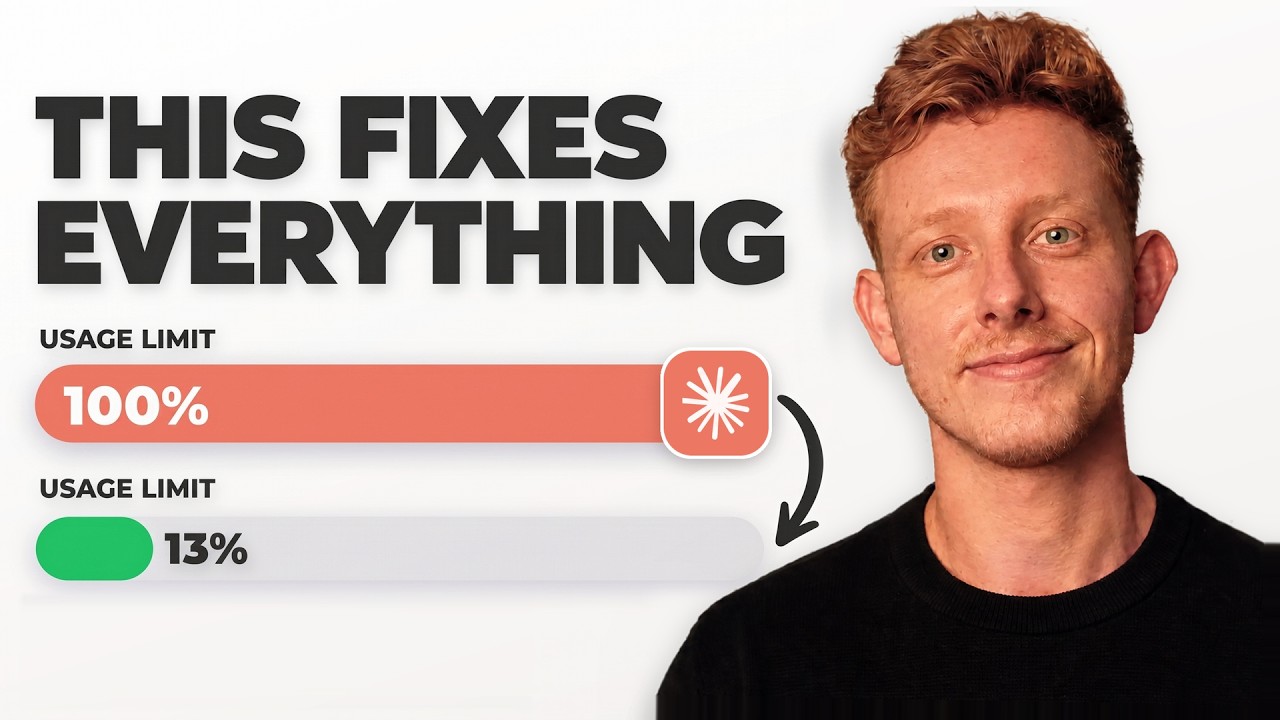
Ben shows how to cut Claude token spend on the newest flagship model (transcribed as "Fable 5.1", i.e. the top Claude model) by telling it to run its sub-agents on a cheaper model like Sonnet. He claims the same customer-intelligence report that cost $350 by default cost $44 with one added line, with near-identical output. He then walks through five more habits: trimming the startup context window, pre-planning prompts instead of iterating, lowering effort level mid-chat, one chat per task, and avoiding three prompt phrasings that Anthropic says waste tokens.
- By default Claude spins up sub-agents on the same expensive flagship model; adding the line "when using sub agents always run them on Sonnet 5" took one report from ~$350 to $44, roughly 80-85% cheaper with near-identical output.
- Sub-agents are still necessary because they keep the orchestrator out of the "dumb zone" — the main model only receives summaries instead of reading every transcript itself and burning through its context window.
- A fresh chat already costs tokens before you type anything (84,000 in his case); typing /context shows the breakdown, and disabling unused MCP connectors, skills and plugins in the customize tab shrinks it.
- Composio acts as a meta-connector so Claude loads one connector instead of 50, routing to the right software without loading each integration into the context window.
- Pre-planning a full prompt beats iterating, because every new message makes the model reread the whole chat; a good first prompt also lets you run at medium effort instead of high or extra.
- His prompting framework has four parts: the full job/goal, the why or intent, guard rails for what could go wrong, and an explicit definition of what "done" looks like so the model doesn't overdo it.
- Opus 5 and the newer flagship now let you change effort level mid-conversation without breaking the cache, so dropping to low effort for final tweaks no longer forces a full reread — but switching models entirely does.
- Use one chat per task, and after roughly 300-500k tokens in a single chat, move to a new session; /compact often loses too much context, so he built a /refresh skill that writes a handoff prompt instead.
- Anthropic's own testing found that dropping "double check your work", excessive emphasis like all-caps "you must always", and fixed step-by-step instructions led to 15% less token spend and 5% more accuracy.
The core claim of the video, with a concrete before-and-after cost on the same task.
When I threw in that exact same prompt with one additional instruction — when using sub agents always run them on Sonnet 5 — it gave me an almost identical customer intelligence report... but this one only cost me $44.
The clearest explanation of why delegating reading to cheap sub-agents improves quality rather than degrading it.
The more tokens a model uses in a chat the worse and the less performance you get out of these models... all it gets back from the sub agents is just a summary of each of these transcripts so it can then actually start doing the analysis while it's still in the smart zone.
So that's almost 80 to 85% cheaper just for this sub agent instruction.
When you start a fresh chat without even having prompted, you're already spending tokens — in my case it already spends 84,000 tokens before I even prompt.
These powerful models tend to do too much, not too little, therefore it becomes very important to define what done looks like.