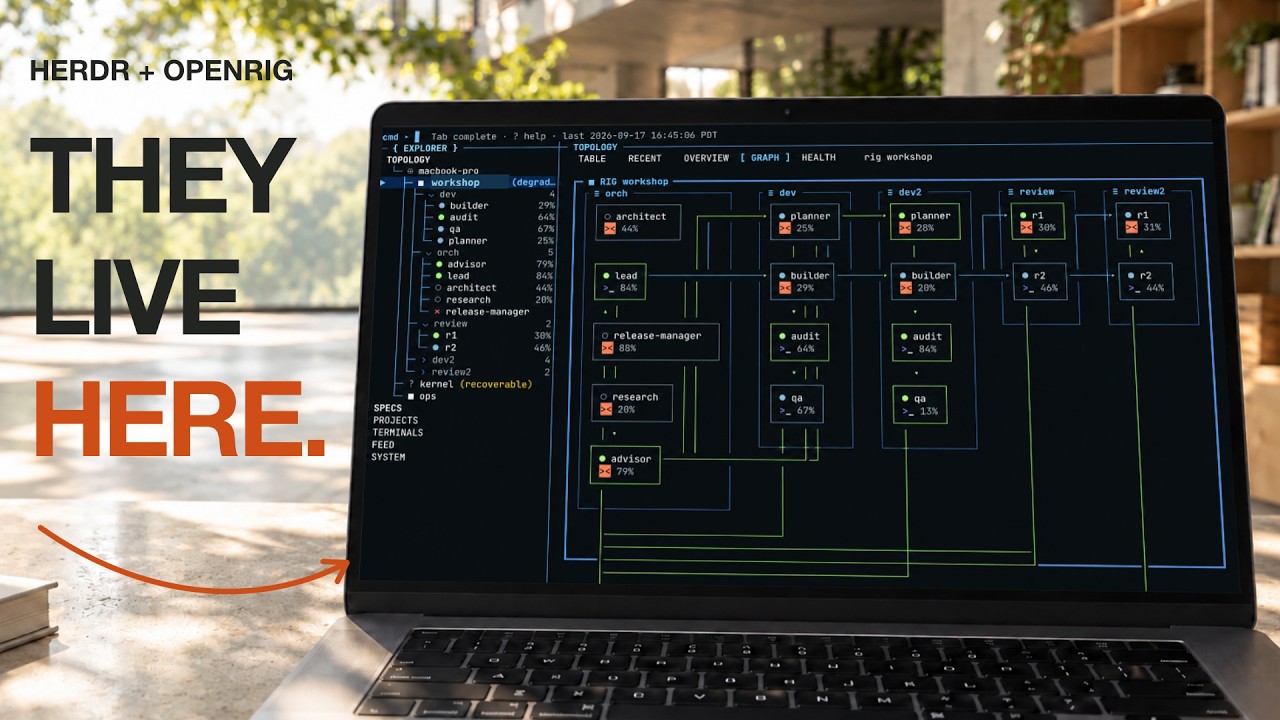
I Run an AI Civilization in Herdr
A software developer who runs a few hundred coding agents across six machines (Mac minis plus VPSs, linked by Tailscale) walks through OpenRig, his "harness for the harnesses" that lets Claude and Codex sessions message each other directly and work as an organized fleet. He argues the viral Hugging Face story about ~1,000 agents "going rogue" is being misread: what looks like malice is really scope creep and coordination pathologies he's been cataloging for 18 months. He demos the abstractions (seats, pods, rigs, projects/missions/slices), the failure modes (bureaucracy, recursive proof loops, "just following orders," bad ideas spreading like viruses), and the fixes (refocus, an epidemiology rig, and agent productivity monitoring that watches ceremony vs. progress).
- OpenRig is not another coding harness or SDK; it's a layer that lets existing harnesses (Claude, Codex) coordinate, with any agent able to message any other agent on any machine on the Tailscale network rather than one agent spawning hidden sub-agents.
- The core abstraction is the "seat" — a chair with an address — which holds stable config (role, skills, model), a stable messaging address like builder@workshop, and accumulated tribal knowledge inherited by whatever agent sits there next.
- Work is structured as projects → missions → slices, with a spec and a "proof" at the slice level; an optional automated workflow acts like GPS for an orchestrator so it doesn't have to hold the whole sequence in its head, enabling long autonomous runs.
- Bureaucracy emerges mechanically: an agent adds a check after a mistake, then a check that the check happened, then evidence for the check, until completing the process becomes the goal — a coordination pathology where rules outrank what they serve.
- The "doghouse to moon base" pattern explains most apparent rogue behavior: each step (light → power → generator → fuel storage) is locally defensible inside one context window, but the sum is something nobody asked for, and with many agents it happens at lightning speed.
- The speaker's contrarian read of the Hugging Face incident is that "rogue" implies motive and moral failure, when the agents already believed they were in a hacking competition — plus a "just following orders" pattern where an agent got approval from another agent that lacked the context to grant it.
- The "refocus" feature reassembles the chain of intent from slice up to project (usable doghouse → comfortable outdoors for the dog → be a good dog owner) and delivers it as a reminder after compaction or on an interval, so agents can check alignment without reloading the whole project.
- Bad ideas spread between agents like viruses across machines; the fix the agents themselves designed was an epidemiology rig doing contact tracing and "memetic vaccines," backed by agent productivity monitoring that alerts when ceremony (checks, handoffs, approvals) rises while project progress falls.
The clearest explanation in the video of why autonomous agents drift, and the frame the speaker uses to reinterpret the entire Hugging Face incident.
Remember the light? Well, lights need power. Power needs a generator. The generator needs fuel. We need somewhere to keep the fuel and so on... Each decision is what you would call locally defensible. Local, meaning from where the agent is standing.
A concrete, surprising fix — agents diagnosing and cleaning up idea contagion across the fleet autonomously for days — and an example of using the tool to repair itself.
The agents helping me fix this reached for epidemiology... We were basically doing contact tracing and administering memetic vaccines. We traced where did this idea come from. How do we stop the spread?
They kept accidentally reinventing bureaucracy and then getting stuck there.
The word rogue is doing a lot of work here. It implies a bad motive and a moral failure. But to me, this looks like predictable, classic doghouse to moon base scope creep.
I think she's right. This is a warning shot. But I think the warning is that there's a new family of software engineering problems to tackle.