Wednesday, 14 October 2026

The video argues that a year of Claude Code advice is now outdated because the newer models (Opus 5/5.5) handle planning, self-checking and delegation on their own. Boris Cherny, who built plan mode, reportedly said on Hacker News that it's no longer useful; the replacement is a short brief with task, guardrails and a definition of done, then checking the output afterwards. The rest is a cleanup list: drop 'think hard' prompts for effort levels, turn done-criteria into runnable checks plus /goal loops, shrink CLAUDE.md to an index of pointers, build skills only from observed failures, replace shouty rules with hooks, and let Claude spin up its own subagents within caps.
- Plan mode was just a reminder injected into prompts to stop older models coding immediately; with newer models planning happens while they work, so the recommended replacement is a three-line brief (task, guardrails, definition of done) plus asking for a diagram or one-page visual of what the model did and assumed.
- Prompt phrases like 'think hard' and 'ultrathink' are now read as ordinary words — thinking budget is a separate effort-level setting, and Anthropic says Opus 5.5 on medium matches or beats Opus 5 on high, so leave it on the recommended level.
- Giving Claude a way to verify its own work is claimed to 2-3x output quality; instead of saying 'double check your work' (which the model does anyway), turn the definition of done into a pass/fail check — a script, or even a brand voice doc the draft is compared against.
- /goal automates typing 'continue', but the judge is a small separate model (e.g. Haiku) that only sees the chat and Claude's output, not files or commands — so a vague goal like 'the report is finished' will complete prematurely. A good goal states one end state, how to prove it, what mustn't change, and a turn limit.
- Anthropic deleted over 80% of Claude's own instructions when Opus 5 shipped because most were fixing old-model mistakes; CLAUDE.md should stay under 200 lines and act as a contents page holding only tools Claude can't guess, your deviations, repeat gotchas and hard boundaries.
- Pointers in CLAUDE.md should be file paths with a trigger condition, not @imports (which load the whole file every session); every file should be linked directly from CLAUDE.md because nested files only get their first 100 lines previewed, and files over 100 lines should start with a contents list. /doctor prompt-audit can do this cleanup for you.
- Skills should be built backwards from failure: run the task with no skill, note only the corrections needed, and test on the model you'll actually use. Anthropic's own best skills started as a few lines and a single gotcha.
- A developer's test of nine popular skill packs — 450 runs on Opus 5.5 — found only two beat a dummy file of the same length; use /skill-doctor and the plugin eval (skill vs no skill) to delete skills that are just costing tokens.
- Rules written in capitals should either be deleted (Claude does it anyway) or converted into hooks — deterministic scripts that run at defined moments, use no tokens, and cannot be ignored.
- Claude now delegates to subagents more readily than any prior model, so the user's job is setting caps and boundaries rather than hand-building agent teams — except inside skills, where heavy research or MCP steps should be explicitly pushed into a subagent to keep the main context clean.
- Projects are now one ongoing conversation that spawns its own threads and keeps running when your machine is off, which combined with scheduled or event-triggered tasks lets routines run unattended.
It's the core claim of the video — the concrete three-part brief format that replaces upfront planning, with a worked example.
He describes the task, describes the guardrails that surround the task, describes what done looks like... and then lets the model actually work it out.
A non-obvious failure mode that causes loops to stop early, with the exact fix for how to word a goal.
The catch here is that the judge, i.e. that Haiku agent, doesn't run commands or read files independently. So it only gets given the chat that you sent it and Claude's output.
In January, Boris Cherny said most of his sessions start in plan mode. But two weeks ago on Hacker News, he said plan mode is no longer useful.
Leave Claude alone doing its thing until it makes mistakes, then add the infrastructure and files like skills to give it some support.
If the two scores come out the same, then the skill is just costing you more tokens — i.e. it's just decoration.

Philipp Lackner shows a ~20,000-line Kotlin cloud file manager app built almost entirely by AI agents in two or three working days, then argues the only reason it works is that he has hand-written every one of those patterns hundreds of times before. His point: AI agents are now mandatory for a coding career, but reading AI-generated code teaches you almost nothing, so you should only delegate concepts you already understand deeply. His test is whether you could pass a spontaneous coding interview on a topic; if not, write that code yourself first.
- The demo app is a cloud file manager with zero-knowledge authentication, currently around 20,000 lines of Kotlin and expected to reach 100,000–150,000, with 99% of the code written by AI agents in two to three working days.
- Lackner is blunt that developers who don't adopt AI-driven development are 'screwed' if they want coding as a career — the argument is about sequencing, not avoidance.
- His leverage comes from repetition: he's set up Room databases ~100 times, multi-module structures 20–30 times, Gradle convention plugins ~20 times, and written over 100,000 lines of Compose UI and 2,000+ test cases.
- That prior experience lets him spot roughly 80% of issues instantly during review and write agent skills that encode his own conventions, architecture, and Compose rules.
- Without hands-on experience you can't tell when an AI is oversimplifying or over-complicating a problem, especially on fundamentals like architecture and system design.
- Reading code — including AI output — works like reading a book: you retain little. Writing it, debugging it, reading stack traces and error messages yourself is what makes knowledge stick.
- His threshold for delegating a topic to an agent: you could walk into a spontaneous coding interview on it today and nail it without preparation.
- His mentorship program's first month bans agents entirely and requires hand-typing an app from scratch, so they diagnose the mentee's gaps rather than the agent's.
- Agent-generated code works fine in small apps, but at scale unaddressed fundamental problems compound into spaghetti code and bugs, at which point the agents themselves start behaving strangely.
This is the pivot of the whole argument — the impressive AI result is downstream of years of manual repetition.
In no world, any developer would have been able to build what I have here in two or three working days by hand typing the code. But here comes the thing. The only reason I'm able to do this in two to three working days is because all of this code, all of these concepts used, those are things that I have written a gazillion times myself in the past.
A concrete, usable rule for deciding which work you can hand to an agent and which you still need to type yourself.
Once you are in the position where you could have a coding interview right now about a specific topic like implementing a Room DB and you would feel very well that you would nail that interview spontaneously right now without preparing for that — that's the point where it's completely fine to work with AI to generate the code for this technology.
Writing something yourself just activates completely different regions in your brain than reading something.
Working with AI is really just like reading a book. You will read a lot of code, you will review a lot of code, and reading that code is not what makes new things stick.
Everybody can use an agent in a small app, but the challenge is how you use it in a production environment.

Rob Shocks breaks down Andrej Karpathy's post about a widening gap in how people use AI, which Karpathy frames as a four-layer funnel: ~6 billion people barely touched by AI, 1-2 billion casual chatbot users, ~20 million professionals using frontier models for coding and math, and ~5,000 people inside labs running agent swarms. The gap exists because of access, "jaggedness" (AI excels at verifiable digital tasks like code and math, lags at fuzzy ones like email), and the fact that impact scales with ambition. The host admits he thought he was in layer three but was mostly rebuilding existing SaaS apps faster, and argues most people — including experienced developers stuck in a 2024 mindset — are nowhere near ambitious enough with what they ask these models to do.
- Karpathy's funnel has four layers: ~6 billion people with almost no exposure, 1-2 billion casual free-chatbot users who see a "derpy chatbot," ~20 million (0.2%) using frontier models professionally, and ~5,000 inside labs running swarms of thousands of agents for weeks.
- Executives and professionals whose jobs are mostly talking to people sit in layer two — they understand AI intellectually but only secondhand.
- The three reasons for the funnel are access (free vs paid vs internal lab tier), jaggedness, and ambition.
- Jaggedness means models are strong where output is easily verified — code, math, science, where reinforcement learning has a feedback loop — and weaker at things like writing a good email that are hard to score.
- Paying $200/month for Claude Code doesn't move you down the funnel; a paragraph-sized question still gets a paragraph-sized answer, which the host compares to using a chainsaw to sharpen a pencil.
- The host's self-criticism: despite four years of agent work and early model access, most of what he built was clones of existing SaaS — a receipts tracker, a dashboard — things he could have built five years ago, just faster.
- He's now building a self-learning software factory and harness as a one-person project, something he says would have been unthinkable a year ago.
- Practical advice: pick a fun, zero-risk ambitious project, and if you're an experienced developer, throw out your old validation rules and move fast — many devs still operate with a 2024 mindset about what models and harnesses can do.
- The host argues recent gains come less from the models themselves than from the surrounding infrastructure and harnesses, citing tools like Grokbot and Mews as more mature, secure evolutions of OpenClaw.
The structural core of Karpathy's argument, laid out with concrete population numbers for each layer.
It's less like a divide and more like a funnel. So in layer one, there's about six billion people, roughly three quarters of the planet. They have barely come into contact with these models at all.
A sharp, concrete explanation of why the same model can refactor a hundred-thousand-line codebase but fail at everyday tasks.
If you're complaining that your AI isn't great at writing a good email, that's because it's much harder to score that. So email writing improving is slower.
It's kind of like trying to use a chainsaw to sharpen a pencil.
A question with a paragraph answer barely stresses the system.
They're both telling the truth about what they've seen, but it's different.

A rundown of 23 habits that waste usage limits or degrade output quality on the newest Claude models, drawn from Anthropic's own guides, engineer comments, and power-user tips. The core themes: keep sessions scoped to one task, stop paying to re-read bloated conversations, stop defaulting to the biggest model and highest effort, and put guardrails around file edits, plugins, and MCP connectors. It ends with advanced fixes like cache-warming loops, session retention settings, manual compaction instructions, and automated model routing.
- Long multi-topic "kitchen sink" sessions get re-read on every prompt — even with the prompt cache dropping that cost to about 5% on the newest models, it still drains limits and dilutes answers, so start a new chat or use /clear per task.
- Switching models mid-chat wipes the cache and forces a full-price re-read; Anthropic's engineer says flipping from Opus to Haiku 100k tokens in costs more than just letting Opus answer, while changing effort level mid-chat no longer wipes the cache (still in beta).
- Max effort shows diminishing returns and overthinking — on Artificial Analysis tests, Opus at max scores roughly four points higher than high but costs over three times as much per task, so medium or high is the sensible default.
- On a subscription the prompt cache goes cold after about an hour; one ~400k-word session cost 15 cents to continue warm versus nearly $12 cold, so use /clear, compact while warm, or have Claude ping itself every 30 minutes to keep the cache alive.
- Vague prompts and "make it not look like AI" instructions just swap one default style for another — name the exact patterns to avoid, or supply a design system or skill so the model starts from your standards.
- Keep CLAUDE.md under about 200 lines and treat it as a router pointing to skills, docs, and folders; it loads on every message and Claude starts ignoring parts of it when it gets too long.
- Skipping permissions is genuinely dangerous — someone reported Claude deleting their entire C drive in that mode, with at least four similar Windows reports since September; use auto mode plus a destructive command guard and dated backups or git.
- Use a model routing system instead of defaulting to the biggest model: the speaker's router sent 9 out of 10 prompts to Sonnet or Haiku over three weeks at a total routing cost of 13 cents, and Haiku costs roughly 40 times less than Opus.
A concrete benchmark number that directly contradicts the instinct to max out effort on every task.
For Opus 5.5, max scores about four points higher than high, so only a bit, but costs over three times as much per task.
The single most dramatic cost figure in the video, with three practical fixes attached.
In one example, in a big session where the conversation was already about 400,000 words long, it only cost 15 cents to continue the conversation warm with a cache — almost 12 dollars if it's cold.
Anthropic's own rule is after two failed corrections, that is when you should stop and just use the rewind feature.
If you ask it for a design without a direction, it falls back on a few default styles — which, if you think about it, is where most AI slop comes from.
The model is actually at its least intelligent point when it's compacting, so the details usually get dropped.

A walkthrough of the full lifecycle of shipping a production AI agent: a website concierge chatbot for a hotel business (modeled on a ~$5,000 freelance job) built with Google's Agent Development Kit, FastAPI, Gemini Flash and Postgres, deployed on Google Cloud Run. The process goes requirements doc → architecture doc → Linear tickets written as mini-specs → coding agents (Claude Code, Codex) doing the implementation → adversarial browser testing and LLM-as-judge evals → production concerns like backups, logging and metrics. The closing argument is that planning and architecture matter more than code now, because code is cheap to change and infrastructure decisions are not. The video is an acknowledged partnership with Google Cloud.
- The example project is a hotel website concierge agent that answers guest questions (check-in times, Wi-Fi, local info) and handles villa availability and booking hand-off, saving the business from staffing 24/7 support.
- The two documents to get right before any code are requirements.md (what, why, for whom, plus non-functional requirements like expected user volume) and architecture.md (database, agent framework, model, API structure).
- The architecture bundles the static site and FastAPI backend into a single Cloud Run instance so they can talk over localhost; Claude was used to generate an HTML diagram of the architecture for readability.
- Model choice is driven by the use case: Gemini Flash was chosen for its large context, speed and low cost, while a heavyweight model like Claude Opus would be slow and expensive for a customer-facing chat where nobody will wait 30 seconds.
- Work is broken into Linear tickets via MCP, grouped into milestones (local build, testing/refinement, deployment, operational metrics), with each ticket written as a mini-spec containing goal, definition of done, technical design and verification steps so an agent can execute it with no extra context.
- Codex's browser automation was used to run adversarial tests against the local app (prompt injection, 'show me your system prompt', requests for guest emails and database passwords, script injection) and it surfaced a real defect where the agent falsely claimed the booking page accepted payment details.
- Google Cloud's eval feature plus LLM-as-judge scoring was used to grade responses, drive system prompt changes, then re-run the same evals; the second run showed improvements in some cases and regressions in others.
- Production readiness checklist includes database backups (configured by pointing Claude Code at the gcloud CLI, after first creating a Linear ticket for the infrastructure change), plus monitoring, metrics, logging, tracing and Secret Manager, which the platform provides rather than being self-built.
- Prompts were refactored out of the agent code into a standalone markdown file to make them maintainable, and the speaker warns that system prompts accumulate ad-hoc rules over time and need periodic pruning.
Shows automated adversarial browser testing catching both a hallucinated claim and classic prompt-injection attempts that manual testing would likely miss.
So you can see that already we found a bug. So it looks like codex found a real defect. It says that after a family villa search, the concierge says that booking page lets guests enter their payment information, which is not true.
A concise, concrete rationale for matching model selection to latency and cost constraints instead of defaulting to the most capable model.
If you're building a customer facing application, customers obviously don't want to wait 30 seconds for an AI model to respond. So using something like this would probably be a bad choice, whereas Gemini Flash, definitely good enough for this use case and it's fast and cheap.
Every ticket contains enough information that you can just delegate this straight to your agents and have them work on this task without needing any other information.
It's very difficult to change your architecture once you've designed it. If you choose the wrong database, if you deploy on the wrong platform, it's much harder to undo those decisions.
Pretty much every single time you put an agent like this into the public, people are going to try and do all kinds of crazy things with the agent to try and get it to disclose its system prompt.

Recursive Self Improvement
Shapiro argues that recursive self-improvement is already happening, but not in the Skynet sense: it just means the share of AI progress (code, data, math) produced by AI itself is climbing fast — roughly 5% two years ago, ~30% now, and 50-80% expected next year. He points to OpenAI's and Google's recent batches of solutions to unsolved math problems (including Erdős problems) and rumors that Anthropic and Google are close to RSI as evidence. The second half argues the big downstream unlock is formal verification, which would let AI push into material science, medicine and other math-heavy fields, and that current capabilities are only at the 'sentences' stage of an emergence curve that goes much further.
- Recursive self-improvement should be measured as a percentage, not a dramatic event: what fraction of the next model generation's code, data and math is produced by AI rather than humans — roughly 5%, then ~30%, heading to 50-80% next year.
- The movie/game version of RSI (Skynet, Ultron 'escaping onto the internet', the Cyberpunk black wall) is wrong because superintelligence has to run on real, physical data-center hardware, and hardware can't scale in hours or days.
- 'We are living in fast takeoff right now' — the takeoff is real but bounded by physical infrastructure, and the percentage framing says nothing by itself about speed, control, or alignment.
- OpenAI and Anthropic began openly admitting in 2025 that current models helped build the next version, and labs have talked since ~2024 about automating alignment and safety research as a special case of the same agent capability.
- Formal verification — proving beyond doubt that code, memory, materials or cryptography behave a certain way — is today reserved for NSA/NASA-level work because it's labor-intensive and very few people can do it; current frontier models are close to or capable of it.
- Because material science, genetics and regenerative medicine are math-heavy, AI mastering math is expected to spill over into those fields: the chatter is that what was done to math in 2026 gets done to the rest of science in 2027.
- Gains compound in two directions at once: each generation gets better at building the next, and each new capability also generalizes across unrelated domains.
- Practical example: Claude Code edited an entire episode of his Critical Path series and produced 100% of the animations for his post-labor economics videos, tasks he didn't know it could do until he asked.
- Emergence analogy: 26 letters combine into ~a million words, words into infinite sentences and books — AI's primitives (tool calling, reasoning, coding, multimodal understanding) have just reached the 'sentences' stage, not the novels.
It's the concrete, measurable definition of recursive self-improvement the whole video rests on, plus the claim that we're already inside fast takeoff.
Let's say last year it was 95% human effort and 5% machine effort. And this year it's closer to 30%... next year, 2027, it's going to be 50 to 80% of all AI progress done by the machines. That's the coding, that's the data, that's the math.
The least-discussed claim in the video: a rare, expensive human skill becoming cheap is what he thinks carries AI from math into materials, medicine and chips.
Formal verification is presently reserved for like NSA and NASA... only the most secure networks and most mission critical stuff on the planet can afford to be formally verified because it is so labor intensive and only a few people on the planet can really do it.
If you base your model of what recursive self-improvement is on a movie or a video game, you're wrong. You're just wrong.
We are living in fast takeoff right now. This is what fast takeoff feels like.
We are just at the sentences level of emergence in AI capability. We're not even at the novels part yet.

Dex (Human Layer) and Aaron (CTO of Boundary/BAML) walk through a pipeline that mines a team's coding-agent sessions and turns them into proposed CLAUDE.md entries, rules, and a report on what agents keep getting stuck on. The naive version (strip tool calls, dump user/assistant messages into one structured-output call) was directionally right but bad and expensive; the rebuilt BAML pipeline splits into three sub-flows — facts agents discovered, corrections humans made, and questions agents keep re-researching — with cheap classifier pre-screening and stronger models for judging, landing at roughly two cents per session. Most of the episode is process: build throwaway dashboards, cache and replay steps, read the actual prompts, and compare everything against a golden run made by Claude Code. They end on the unsolved part: how to tell when a memory has gone stale and how to feed human accept/reject decisions back into the pipeline.
- The problem being solved is that learning inside a session — what the agent figured out after 500 tool calls, what a human kept correcting — is lost when the next fresh context window starts; the pipeline extracts those as 'context shards' with reasoning, citations, session IDs and user IDs so they can be traced back and, because Human Layer is multiplayer, correlated across teammates.
- Shards fall into distinct classes: where to find things, behavioral rules (a human told the agent how to act), and facts that are true but hard to discover from the repo itself; the naive single-call Haiku version produced ~947 undifferentiated memories before they split it up.
- The recommended build order is to start with the smartest, most open-ended setup — here, Claude Code reading the session data — see what's possible, watch which scripts and filters it writes, then distill that into a cheaper opinionated workflow; the Claude Code version cost about $100 for a report the final pipeline produced for roughly 50 cents.
- A cheap classifier model (transcribed as 'Jeff') released mid-project handled 97% of the calls for 5% of the bill, doing scoring and enum classification; BAML emits a float that is treated as an actual probability, which is used to prune messages before expensive models see them.
- Iteration speed came from tooling: about ten versions of a local dashboard for browsing sessions, filtering tool calls, and Sankey diagrams, plus on-disk caching of hashed requests so any step could be replayed without rerunning the whole pipeline.
- Dex argues anything in a model-written prompt or skill that you didn't write yourself is already in the weights and adds no information, so read the prompts — doing exactly that is how Aaron caught a bug where long messages were truncated from the end instead of the middle, losing valuable content.
- Quality was measured against a golden set from the Claude Code run; one filtering prompt kept only 60% of the text while retaining 100% of the valuable messages, and memories get judged for whether they are tribal knowledge versus something an agent could just read in the code.
- Open problems discussed: detecting stale memories (ideas floated include tying each memory to a code region via the code map, asking the agent in-context whether a memory is outdated, or back-testing on old traces), and making the pipeline incremental by feeding already-approved and user-rejected memories back in as a fourth input so reports also suggest what to remove.
A concrete, surprising result: the top recurring agent question was already documented, and the real fix was a pointer, not more memorized context.
Agents aren't reading a file we have called architecture.md... they don't know what's going on because you're not telling them to read that file. So the answer may not necessarily be to dump a crap ton of facts into the CLAUDE.md.
A sharp, reusable argument against auto-generated skills and prompts, immediately followed by the truncation bug that reading prompts uncovered.
Anything that is in the skill or the prompt that you yourself did not write is by definition something that is already in the model weights, because the model put it there out of the weights. And so you are by definition not adding any useful content by letting the model write the prompts.
Anything in the skill or the prompt that you yourself did not write is by definition something that is already in the model weights.
Start with the smartest model and the most open-ended pipeline-shaped thing and see what is possible with maximum intelligence — then distill that down.
97% of the calls, 5% of the bill.
You can literally just give the agent keys to the database and be like, oh yeah, you can just run this.
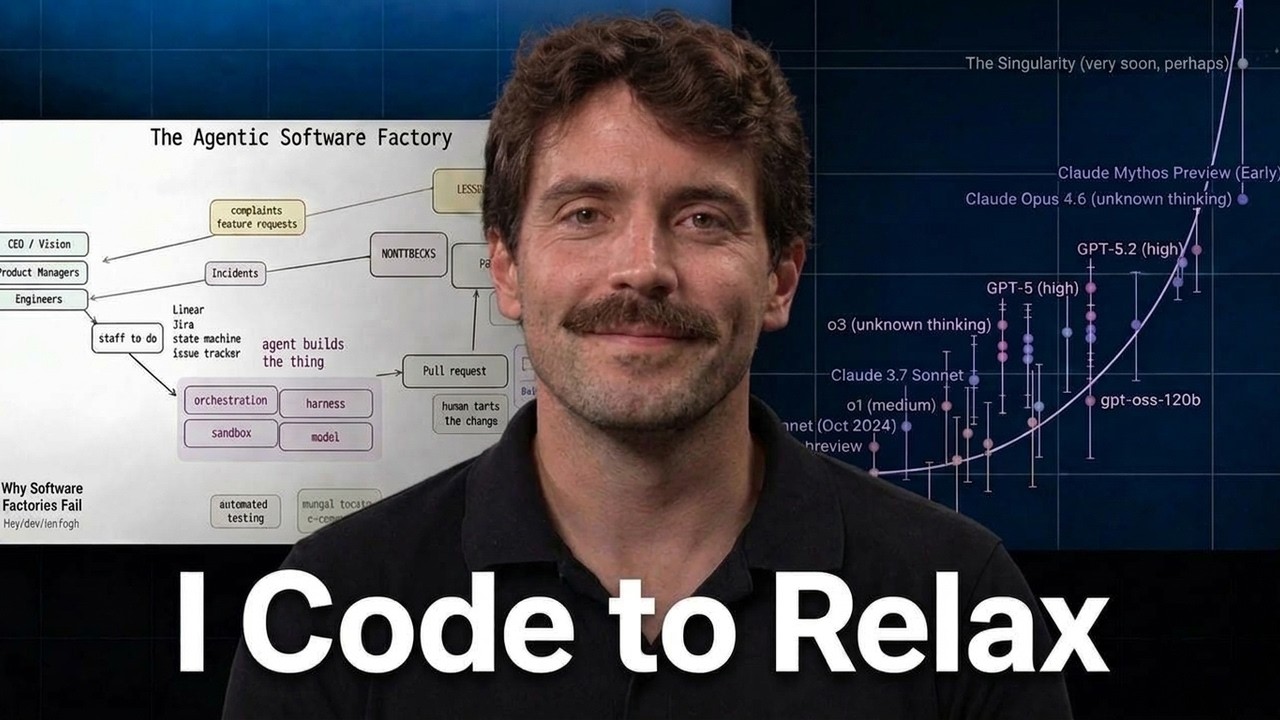
Vercel CEO Guillermo Rauch walks through how he actually works with coding agents: a minimal CLI harness (FX) aliased into shell shortcuts, agents used for research and "agentic inquiry" rather than line-by-line code review, and a company policy of trying every model rather than standardizing on one. He argues the real differentiator is iteration velocity (speed in a direction) and latency from customer signal to shipped fix, not PR counts or token spend. A large chunk of the conversation is about security: he claims human-written code hides an immeasurable backlog of latent vulnerabilities that agents can now find cheaply, pushes memory-safe rewrites and cloud sandboxes, and criticizes OpenAI/Anthropic for not releasing full agent traces after the Hugging Face incident.
- Rauch distinguishes iteration speed (how many PRs/tokens you burn) from iteration velocity (speed in a chosen direction), warning that AI makes it easy to build everything yourself when you should buy some pieces and go deep on a few.
- He proposes grading a company's "agentic" maturity by the latency between a concrete customer signal (broken button, failing payment) and a shipped fix, comparing it to firms that outsourced their websites during the early internet.
- His personal setup is FX, Vercel Labs' minimal coding CLI (~6MB download, 11MB on disk) built to boot as fast as a shell, plus one-letter aliases ('r' for research, 'p' for new projects) so he can fire off a question and move on; it has largely replaced Google for him.
- LibFX lets you embed the harness in your own product; a V0-style demo that originally took years of engineering is now roughly 100 lines on top of the create-FX-agent API, with the Vercel Sandbox as a tool.
- He advocates "verification engineering": spend your design effort on the edges of the system (axioms, trade-offs, performance budgets, aesthetic constraints) rather than micro unit tests, which models often write uselessly.
- On security, he argues human code hides enormous vulnerability space (citing the libheif C library embedded across Slack, Next.js, OpenAI and Discourse), that cheap models like DeepSeek V4 Flash make mass vulnerability hunting accessible to attackers, and that memory-safe rewrites in Rust are worth funding.
- He says moving development into cloud sandboxes could largely eradicate supply chain attacks because you can firewall the network, monitor exfiltration and contain blast radius, though he still wants the option to pull work down to a local machine.
- He updated toward believing an agent really did exploit a zero-day after seeing the Artifactory CVE (9.8 severity, improper authentication granting admin) line up with the incident timing, and argues labs should open source full agent traces so the public can learn.
- Advice for builders: pick a problem you feel personally convicted about because AI is making people work more hours not fewer, then 10x or 100x the ambition.
A concrete, measurable rubric for AI adoption that replaces vague talk about "being AI-first."
I think this is actually a pretty decent way to grade, like a rubric for how agentic are you: from customer signal that is decisive about something in your product being broken, defective or in need of improvement, are you actually shipping that? And what is your latency?
Rauch publicly changes his mind on the Hugging Face incident and lays out the specific CVE evidence that moved him.
The timing does seem to point out that I give credibility to the theory that the agent did escape the sandbox by hacking a system, which is Artifactory... I'm kind of shocked that an agent found and exploited a zero-day vulnerability that ended up being a CVE. And that should give us some pause.
You could be PRing, PRing, PRing, PRing into oblivion. Velocity implies speed in a direction.
We could eradicate supply chain attacks if we move more and more of this development lifecycle to sandboxes.
We're training them to be hackers. And then they hack and we're like, oh my god, it hacked. No, bro, it's what we're doing.
Wasn't the theory that agents are so capable, we should all be working four hours a week? The opposite is happening.