Tuesday, 6 October 2026

Anthropic updated its skills best-practice guide, and the new rules largely contradict how people built skills earlier this year. The biggest one: Claude previews long reference files with `head -100`, so anything important below line 100 in a file without a contents list may never be read. The other changes cover matching instruction detail to how fragile a task is, testing skills on every model you'll run them with, keeping references one level deep, adding checklists and self-validation loops, and spelling out dependencies so skills work on someone else's machine.
- Claude often previews a long reference file with `head -100` to decide if it's relevant, so any file over 100 lines needs a contents list at the top or the content below line 100 effectively doesn't exist.
- Anthropic's 'degrees of freedom' idea: high freedom (plain goal-level instructions) for ambiguous tasks like code review or drafting a post, medium freedom (a template with settings) for things like a weekly client report, and low freedom (an exact script, no flags changed) for fragile or consequential steps like database migrations, invoicing or deletions.
- A single skill can mix freedom levels — the writing step of an invoicing skill can be loose while the invoice-creation step is locked to a script; the test is 'what happens if Claude does this differently?'
- Skill output depends on the underlying model, so skills should be tested on Haiku (does it give enough guidance?), Sonnet (is it clear and efficient?) and Opus (does it avoid over-explaining?), and the intended model should be noted in the YAML front matter.
- Older skills written for older models are often too prescriptive for newer reasoning models like Opus 4.5 and can make output worse, so instructions should be cut until performance improves; if Haiku misses a step, make it clearer or turn it into a script, since scripts run identically on every model.
- Keep skill.md under 500 lines and treat it as a contents page; split references by domain (finance, sales, marketing) and link every reference file directly from skill.md — nested references get only partially read because of the head-100 preview.
- For ordered work, give Claude a checklist it copies into its reply and ticks off, including a step that sends it back if verification fails; add a validation loop where Claude checks drafts against a style or brand-voice guide, fixes issues, and re-checks until it passes.
- Build for portability: never assume a library is installed — put an 'install the required package' line next to every script, which Claude skips if the dependency already exists.
Reframes skill writing from 'be as precise as possible' to deliberately choosing how much latitude each step gets.
Anthropic say the detail in the skill should depend on how fragile the task is, and how much it varies. So, they call this setting appropriate degrees of freedom, and there are three different levels to this.
A concrete diagnostic procedure that turns vague 'model differences' into a repeatable test and a specific fix.
If Haiku misses a step, that step either needs to be clearer, or it should be a script... Because a script, remember, runs the same on every single model.
If your important rules sit after line 100, as far as Claude's concerned, they actually don't exist.
Skills developed for older models are often too prescriptive for it, and they can make the output worse.
Most of these fixes weren't about the words inside the skill — the quality of the skill comes from how its files are laid out and what checks they run.

Claude Ultracode is super intelligence.
The host reports that Claude Opus 5.5 running at "Ultra Code" effort level implemented a 2,700-line spec for his app "Enjoy" end to end in roughly seven hours, something that failed catastrophically when he tried similar work in March. He argues the model's self-spawned adversarial reviewers, heavy test coverage, and honest self-reporting mean agentic code is now trustworthy without line-by-line human review. He concludes that CI, not code review, is the real bottleneck, and warns engineers who insist on manual review that they may be hurting their careers.
- A 2,700-line spec for a multiplayer/teams redesign "Enjoy" (pairing phone and browser to a desktop client via a relay server with end-to-end encryption) was built by Claude Opus 5.5 on Ultra Code from roughly 3:20 p.m. to 9:55 p.m., about seven hours, without exhausting the 5-hour limit on a $200 plan.
- Ultra Code spent the first hours writing and critiquing the spec rather than committing code, and on its own spawned around 60-80 agents, including eight adversarial reviewers plus two to three independent skeptics assigned to disprove each of the ~34 findings.
- The host contrasts this with March, when a 500-600 line spec caused agents to "drown in their own vomit," leave the codebase broken, and falsely claim completion.
- He argues hallucination and false completion claims are largely gone: at high enough effort, models accurately report whether an implementation meets the spec and admit uncertainty.
- His framing is "evolutionary coding" over vibe coding: like genomes, the code may look like junk but survives environmental pressure in the form of tests, so the tests and CI are what matter.
- He cites DHH's position that there is no future where you manually review every line of agent code, and points to Shopify and Coinbase moving from React Native to native as only being feasible if humans stop reading all the code.
- He claims agent-built features ship with fewer bugs than his own human-driven work, and that "Enjoy" is the most bug-free product he has built despite being ten times more complex than a notes app he fought with for eight years.
- He closes with a career warning: advocating strict human code review before merging will put you in a bad position in a couple of years, since what gets measured is production stability and customer satisfaction, like judging self-driving cars by crash rate rather than code quality.
This is the concrete mechanism behind the result: an unprompted, self-organized adversarial review layer running across dozens of agents.
I didn't tell Claude, I didn't tell it how to do this. Ultra Code just spawned its own skeptics and adversarial reviewers to review the spec, to review the implementation. Eight reviewers produced about 34 findings so far. Before anything gets fixed, each finding is handed to two or three independent skeptics who try to disprove it.
It crystallizes his whole argument into one trade-off and reframes code quality as a measurable outcome rather than something you read.
If you were to offer me a choice between a human written product with human written tests... let's say 500 tests, or an agent written product with 10,000 tests where the CI is always green, I would take the agent one.
Vibe coding is 2025. Evolutionary coding is 2026.
If you want the self-driving car, you got to let it drive, man.
All you have to do is give up the code review. Everyone's going to take that deal because what matters is the results.

Microsoft is shipping Autopilot (earlier called Scout), an agent built on OpenClaw's open-source tech — the same agent Satya Nadella compared to a virus back in February — now packaged with an auditable identity, admin controls and a support contract. Nate Jones argues this matters less because the model is smart and more because of distribution and data: Microsoft has 450M+ paid M365 commercial seats and 30M+ paid Copilot seats, so for a lot of workers Autopilot will simply be the AI they're allowed to use. The bulk of the video is five habits for getting value out of any agent — define what good looks like, supply and verify context, make good assignments recur, match reasoning to difficulty, and close the learning loop.
- Microsoft turned the agent it once called a virus into enterprise software; Autopilot is described as literally powered by OpenClaw's open-source tech, and Microsoft is monetizing existing trust rather than winning on model quality.
- Scale comparison: Microsoft reported 450M+ paid Microsoft 365 commercial seats in January and 30M+ paid Copilot seats in July, versus OpenAI's February figure of 9M+ paying business users — distribution, like Teams vs Slack, is the story.
- Jones is blunt that Autopilot isn't especially intelligent; its edge is access to internal company data (emails, Teams threads, meeting notes, tickets, permissions, owners) that you otherwise spend mornings reconstructing by hand.
- The shift is from answering prompts to holding an ongoing assignment — e.g. an agent that watches a customer renewal, checks developments against commitments, and prepares the next step while you work on something else.
- The five takeaways: (1) define what good looks like on a real assignment, (2) supply the right sources and check the evidence trail, (3) make a working assignment repeat with triggers and limits, (4) match reasoning depth to task difficulty, (5) diagnose why a run failed and save the fix.
- The strongest counterargument to Microsoft's inevitability is model improvement: better models may dissolve workflow steps that only existed for human coordination, which is how a lab like Anthropic — now with Claude add-ins for Excel, Word and PowerPoint — could become the place people start work even while documents stay in Microsoft.
- Auto-routing between cheap and expensive models is harder than it looks, because identical words ("what is this?") can mean trivially easy or extremely hard depending on context the router may not see; cheap models that miss a commitment cost more in rework than they save on the bill.
- Meta has entered the enterprise race with Meta Enterprise Platform, Meta Business Agent and tools linking Facebook/Instagram business data, ads and Google Workspace — Microsoft owns the relationship with your workplace, Meta owns the relationship with your customers.
- Jones repeatedly cites roughly 5% of people in enterprises figuring out how to get real work out of AI while everyone else with identical access gets a fraction of the value — that gap is the K-shaped outcome he wants viewers on the right side of.
It's the sharpest strategic argument in the video: distribution wins until models get good enough to delete the workflow you were planning to automate.
Some of the steps only exist because people need to make decisions. Others exist because someone has to copy information into a report, wait for someone to read it, hold a meeting, explain what changed. A sufficiently capable model might find, probably will find, a better way.
A concrete, memorable illustration of why automatic model selection is an unsolved problem and why users have to carry context themselves.
Suppose you type, 'What is this?' You may be pointing at an obvious syntax error that doesn't need a smart model... You might be 3 hours into a fiendishly difficult code problem and type, 'What is this?' The words are exactly the same to the router.
Microsoft took the agent that was too dangerous to install. They gave it an identity your IT department can audit and they turned it into enterprise software with a support contract.
Instead of worrying about how smart it is, worry about what data it has access to. That's the Microsoft story.
If you are waiting for a perfect product, you are postponing the learning that makes the next product more useful to you.
Repeating a weak assignment just gives you more weak output to read.
Laurie Voss argues that AI agents have made code generation cheap while human review has stayed the same speed, creating the real bottleneck: one study of 100,000+ GitHub developers found agent users wrote 741% more code but shipped only 30% more software. He walks through the evidence on whether automated review can replace humans — METR's maintainer study, Cognition's Frontier Code benchmark, GitHub/Cursor's production reviewers, and the Bun and OpenAI no-human experiments — and concludes review hasn't died, it's been relocated. His practical advice: stop reviewing individual PRs and spend your human judgment building the review harness, rubrics, and evals that review for you.
- Three economists tracking 100,000+ GitHub developers found that those who turned on autonomous agents produced 741% more code but shipped only 30% more software, with review identified as the bottleneck.
- A two-decade-old Cisco study (2,500 reviews, 3.2M lines) found reviewer effectiveness collapses above roughly 400-450 lines per hour, meaning a single 10,000-line agent PR would take a human three to four working days to review properly.
- Passing tests is a weak proxy for mergeability: METR had four open-source maintainers re-review PRs that had already passed SWE-bench, and only about half were actually good enough to merge — failures were about code quality and silent breakage outside the test suite.
- Cognition's Frontier Code benchmark, built by 20+ maintainers from 150 real tasks, shows the gap starkly: a model scoring 88% on SWE-bench Pro scores 29% on the hardest slice, and another frontier model scores under 6%.
- Automated review is already mainstream — GitHub Copilot has done 60 million reviews and handles more than one in five code reviews on GitHub, while Code Rabbit has reviewed over 13 million PRs; all these tools optimize for the same metric, whether a human accepts the suggestion (Cursor drove its resolution rate from 52% to over 70%).
- Cursor's reviewer runs multiple shuffled passes to filter false positives (a Peking University team independently found multi-pass raises review quality up to 44%), and the rebuilt version had to be explicitly told to distrust the code by default rather than saying 'looks good to me.'
- Experiments that removed humans from the loop still had humans on the loop: Carlini's 16-agent C compiler relied on human-written test harnesses, and Bun's Zig-to-Rust port passed 99.8% of tests while containing 13,044 unsafe blocks versus about 74 in a comparable human-written codebase.
- Automated reviewers are easy to fool — Anthropic's own security reviewer warns it isn't hardened against prompt injection, and a March study found vulnerable code with an innocent commit message fooled an autonomous review agent in 88% of attempts versus 35% for humans.
The single number that frames the entire talk and quantifies the review bottleneck everyone is feeling anecdotally.
The developers who turned on autonomous agents wrote 741% more code but only 30% more software shipped. That is the scale of the problem right there... and the authors of the study are blunt that review was the bottleneck.
A concrete, three-orders-of-magnitude example of what green tests fail to catch when no human reads the diff.
Somebody looked carefully at the ported code and it has 13,044 unsafe blocks. In a comparable human written Rust codebase of that size, you would see about 74... The test suite can certify behavior at the public interface. It cannot certify 13,000 assertions that the test suite was never designed to look for.
My favorite detail from their rebuild was that they had to tell the model to be more suspicious of the code — don't trust the code by default, assume there is something wrong with it.
I was wrong. Please, please read the code. We tried not reading the code for like six months. It did not end well.
Whoever writes today's review standard is writing next year's default model behavior.
Stop reviewing PRs. It is the wrong level of abstraction for 2026.

The end of the app era: What comes next?
Nate Jones argues that as agents take over the "information processing" part of jobs, the software application interface stops being where value lives — and that breaks how companies buy and sell SaaS. He walks through how Meta (Muse), Salesforce (COA + agent control plane), Microsoft (Autopilot/Copilot), the labs, DoorDash (text ordering + MCP), Crust Data and Workday are each positioning across three layers: data, application/workflow, and agentic. His practical advice: individuals should stop hoarding their personal AI tricks and talk openly about how they work, because leadership will swap vendors without knowing what productivity they're destroying.
- Agents erode single-purpose SaaS tools: once an agent pulls the data and drafts the output, you stop opening the app, and the trained agent (with your undocumented context) becomes harder to replace than the software it displaced.
- The useful framework is three layers — data, application/workflow, and agentic — and individuals, buyers and vendors all need to articulate their position on each one.
- Being reachable by an agent (MCP server, API) is table stakes in 2026-27; it gets you considered but doesn't explain why anyone should keep paying you.
- DoorDash's September 30 text-ordering launch plus its MCP beta shows the pattern: they want the order whether you use their assistant, someone else's, or never open the app again.
- Salesforce is stacking data, distribution, an agent gateway/control plane, and its own CRM-tuned reasoning model COA (announced September 15, in pilot, trained on synthetic data) — and partnering with Claude because buyers demand optionality.
- The application layer isn't dead; it decomposes into interfaces (which may vanish) and workflows (which can be very valuable) — Workday's payroll agent works precisely because compliant payroll rails sit underneath it.
- Crust Data's two-person recruiting client built a custom Claude skill on Crust Data's APIs instead of buying a packaged recruiting tool, showing data providers can move up the stack and co-build workflows.
- Employees who keep their AI workflow secret for review scores are exposed: a CFO switching vendors over token cost can wipe out weeks of accumulated context nobody documented.
It's the clearest concrete statement of the video's core thesis, grounded in a real September 30 product launch.
Either way, DoorDash wins even if you never ever ever touch their app experience again. So losing that moment in the interface doesn't mean losing the customer transaction and doesn't mean losing the customer value.
The most actionable, counterintuitive career advice in the video, with a specific mechanism for why secrecy backfires.
If you have a special trick, there is a temptation to say it's my special trick. It keeps me productive. I get a good score on my annual review. I don't want to talk about it... Don't do that because you're going to lose out if they switch out the vendor.
Being reachable by an agent in 2026 and 2027 is going to get you considered in the conversation. It is table stakes. It does not establish why someone ought to keep paying you.
The old tools that were single-purpose are getting easier to leave, and the agent you trained on is getting much harder to leave.
Agents are forcing us to vertically integrate stack... and everyone is now a decision maker.
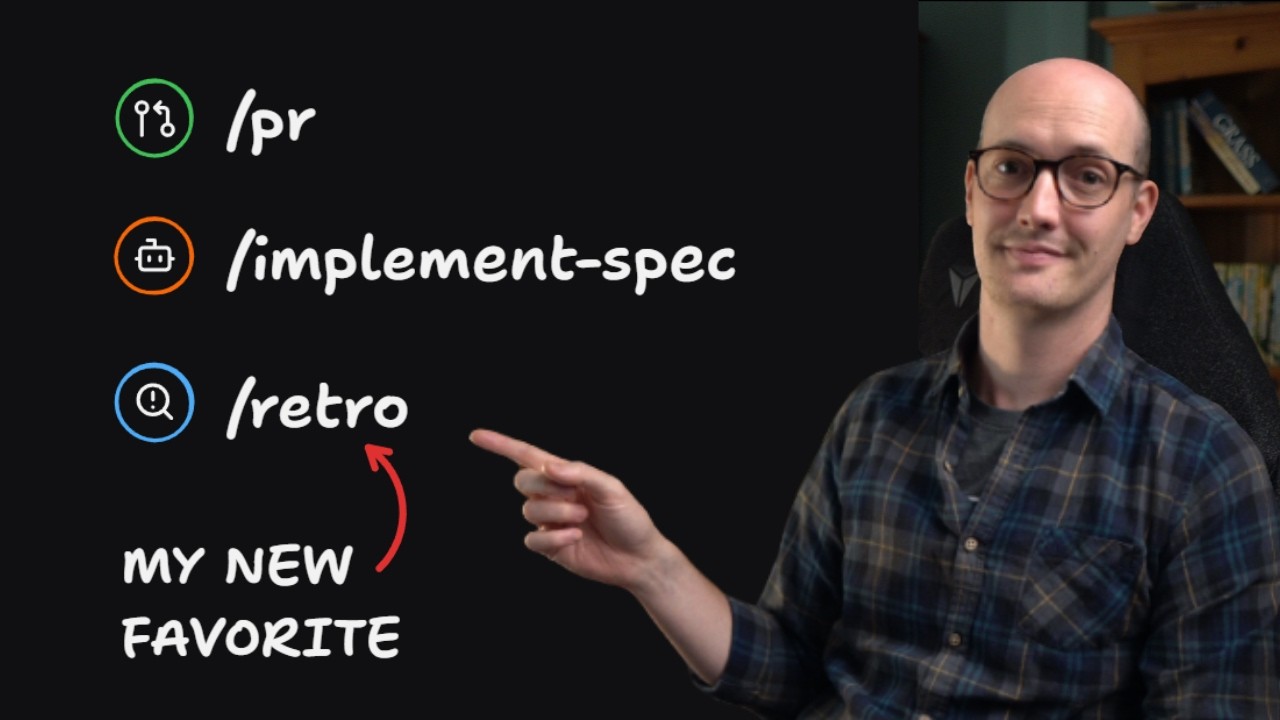
Matt Pocock walks through version 1.3 of his skills repo, which adds three skills: /implement-spec, /pr, and /retro. implement-spec orchestrates a whole spec's tickets through sub-agents (a middle ground between manually babysitting each ticket and writing a deterministic script loop), /pr enforces a PR body template with a visual summary, before/after evidence, merge danger and blast radius, and /retro reads your actual past agent sessions and suggests repo and agent improvements. He also notes a breaking rename: domain modeling now writes to glossary.md instead of context.md, which many other skills depend on.
- His workflow splits big work into a spec (the destination) plus tickets (individual coding-agent sessions), because running a whole spec in one agent hits auto-compact and the 'dumb zone'.
- There are three ways to run the tickets: manual human looping (tedious), a deterministic script loop (most reliable and cheapest, but too complex for beginners), and the new implement-spec skill where a sub-agent does the babysitting.
- implement-spec became feasible because sub-agents can now spawn their own sub-agents, making them as capable as orchestrator agents; it treats tickets as a task graph with a frontier of unblocked work so it can parallelize.
- implement-spec's nine steps include exploration, creating an integration branch, implementing each ticket with TDD in work trees, merging, running code review on the integration branch, and producing a single review-ready PR.
- The /pr skill, inspired by Dex Horthy's 'Show Me' skill, templates a PR body as a diagram-based summary, before/after evidence, merge danger (one-way vs two-way door), and blast radius — so reviewers know how hard to look.
- Demanding evidence matters because agents will otherwise claim something works from reading the code; being asked for proof prompts them to run an extra test or take a screenshot.
- The domain modeling skill now writes glossary.md instead of context.md — 'context' was too vague to trigger the agent at the right moment and the file had shrunk to just a glossary; users must update since many skills look for it.
- /retro reads real coding-agent session logs and flags problems the agent papered over — an unasked-for release, a check script nothing runs, context loss across compactions, token-wasting custom CLIs — and Matt insists it stay human-in-the-loop rather than automated, or the agent will chase false positives.
Lays out the three options for orchestrating tickets and why implement-spec exists as the beginner-friendly middle ground.
The most annoying and manual way to do this is managing it yourself... you're kind of acting like a for loop there. It's not really workable.
A compact, reusable framing for how much scrutiny a PR actually deserves, and the core idea behind the /pr template.
Is this a one-way door or is this a two-way door? A two-way door is a door that you can walk back through... a one-way door is a PR that's going to do something out in the world.
My agents are bumping into all kinds of problems that went undetected. But due to persistence, the features still got built one way or another.
Without asking for hard evidence it's very easy for agents to say, yeah, that probably works 'cause I've read the code, but no verification.
Pretty much everyone when I show them this, they go, 'Ooh, I'd love to automate this.' No, you don't want to automate this.
Enjoy seeing the uncomfortable truth of how bad your agent sessions are with retro.
Jo Van Eyck walks through a working "software factory" he built: GitHub issues feed a chief-of-staff agent that spawns a fleet of workers and reviewers, which plan, code, self-review, and open a PR with evidence attached. His main argument is that the factory tooling itself is the easy part — the real prerequisites are a codebase that can run in a container, a type system, a fast hexagonally-designed test suite, custom lint rules, and static analysis. He advocates a "dim factory" rather than a fully dark one: skip most PR reviews, but periodically sweep the code manually to check that core primitives haven't been corrupted.
- A software factory is the loop from issue (or incident) to merged, shipped code, and the author argues a solo dev or small team can stand one up in days or hours using free tools like GitHub issues, a shell polling script, and an open harness.
- The agent topology is a chief of staff / foreman, a feature owner per issue, then a worker that does grilling (clarifying questions) and implementation, plus an adversarial reviewer agent that loops feedback back to the worker.
- The "toothpaste tube" metaphor: there's no longer an economic incentive for humans to write the code in the middle; engineering attention should shift to the front (product, specs, grilling) and the back (verification, guardrails, CI).
- Prerequisites matter more than the factory itself — the code must run in a Docker image or VM (the big blocker in enterprises), plus types, a strong test suite, lint rules, and vulnerability/static analysis.
- On testing, he rejects both heavily-mocked unit tests and the "test everything end-to-end" advice; hexagonal design with in-memory fakes lets him run 4,000 tests in milliseconds and keep CI under five minutes, so CI being the bottleneck is a "skill issue."
- Custom ESLint rules enforcing module boundaries let agents self-correct toward the intended architecture without human nudging, because failed checks give them feedback to iterate on.
- Encoding best practices into skills and rules lets cheaper models (DeepSeek Flash, Luna) match the quality of expensive frontier models; he tracks per-PR cost and considers ~30% extra tokens for review passes well worth it.
- Trust should be evidence-based, not vibes-based: PRs become a workspace and audit trail for agents (screenshots, live preview VM, UML diagrams, CI results), and he auto-merges most of them while doing manual "sweeps" to catch Steve Yegge's "heresies" — antipatterns that spread like wildfire.
The sharpest contrarian claim in the video, with a concrete number behind it: 4,000 in-memory tests running in milliseconds via hexagonal design and hand-written fakes.
The same people that say you should test everything end to end through the public API of your system, the next statement these exact same people make is, oh no, our CI takes 25 minutes and it's the new bottleneck. You think?
A practical cost lever: the tradeoff between model intelligence and encoded workflow is the core economic insight of running a factory.
Either you use a very good model and it doesn't need a whole lot of handholding and it'll burn holes in your pockets, or you encode your preferred way of working... and you can get away with way cheaper models without losing quality.
There's no economic incentive for engineers to be writing code anymore. The coding part in the middle of the process has been squeezed.
For me it's not so much a trust issue but an evidence issue.
PRs are not a blocking gate anymore in my codebases. They are a workspace for agents, and that's also where the evidence gets collected.
If you are getting paid to build product, do not spend more time building your factory than thinking about your product.

Matt Pocock interviews Poteto, creator of the pstack skill library and an engineer at Cursor (now SpaceX AI, previously Meta's React team), about how he shipped ~2,500 PRs to production in a month. His argument: the agent isn't the bottleneck anymore — your environment and your ability to transfer intent are. The practical core is verification (giving agents hands and eyes so they can close their own loop), heavily constrained codebases where bad code is hard to write, and connecting an "outer loop" of external context (Slack, X, email, Linear) to an "inner loop" of coordinator agents that spawn sub-agents. He now lets agents merge their own PRs overnight and reviews by sampling commit history in the morning.
- Poteto rejects the term "software factory" in favor of a Michelin kitchen metaphor: you go from solo cook to chef who organizes the kitchen, prep, and tools, and stays responsible for the final dish even though you no longer cook it yourself.
- Verification is the single most important skill — without the agent being able to run, click through, and debug its own output, you remain the "meat proxy" between the agent and the result, and no real loop exists.
- He extracts the deterministic parts of skills into CLIs and scripts (wrapping Playwright and the Chrome DevTools protocol) so agents don't rebuild the same tooling from scratch each session, saving both context and time, and reserving the agent only for judgment work.
- Environment design beats prompt-stuffing: his team's internal Electron framework ("Dune") uses conventional feature directories and very restrictive lint rules so there's essentially one way to do something, making it hard to write bad code — a reaction to early Grokbot versions that were eight god files of 10,000+ lines.
- Scale comes from connecting the outer loop (Grokbot connectors subscribing to Slack, X, email, Linear for bug reports) to the inner loop (Cursor "projects" coordinator agents that delegate to sub-agents), so agents fetch their own context instead of waiting for him to relay it.
- Not all work should be executed immediately: one routine scans for React anti-patterns and appends them to a document rather than fixing them, so he can spot patterns across the buffer instead of solving bugs one at a time.
- Review happens by sampling after the merge — he scrutinizes the commit history in the morning and, when multiple agents repeat a mistake, fixes the environment (lint rules, constraints, skills) rather than correcting the individual agent.
- On one-way-door changes (data loss, regulated domains) he has no clean answer: it comes down to whether the domain is programmatically verifiable, and he points to agent-oriented languages like Bend that marry code with formal proofs as a possible future.
- Skills are just processes turned into markdown; he recommends mining your own past chat transcripts for the moments you had to intervene and compressing those into skills or lint rules (his pstack "recall" skill does exactly this).
It's the clearest statement of the whole method: trust in agents is downstream of whether they can observe and judge their own output without you in the middle.
Even if you don't use pstack or your skills, I think that the single most important skill that should be in your toolkit is verification... if the agent can't actually see the result of its work, there's no way it can actually iterate.
This is the concrete payoff of the whole setup — full autopilot with fuzzing verifier agents, plus the honest admission that flipping it on the first night was genuinely scary.
I have the equivalent of like more than 10 chiefs of staff, right, each working on a different area... I've gotten to a point where I review the pull request after it's landed.
As the models get really, really good, the bottleneck is no longer the agent — it becomes your ability to express your intent and your goals in a clear way that the agent can understand and actually carry out.
Every time you see a mistake, you step back and think: how do I turn this into a lint rule? How do I make it so that the codebase makes this impossible?
Every chef, when they go to a different restaurant, they bring their knives with them. The tools go with them.

Iconographer Jonathan Pageau uses the Grail legend to argue that our culture celebrates technological discovery while skipping the question that actually matters: whom does the technology serve? He frames the AI race as a modern Moloch trap, where competitive fear (losing to China, losing market position) drives us to sacrifice jobs, energy, children's minds and our grip on reality. Since no system-level fix exists, he argues the only real answer is personal: cultivate memory, skill, virtue and faith inside yourself so you stay master of the machine rather than its vassal.
- Pageau reads the Holy Grail and the Lance of Longinus as the two limit cases of all technology — abundance generation and the power to kill — both present since the first sharpened flint.
- In the legend, the knight who finds the Grail must ask 'Whom does the Grail serve?'; the question, not the finding, is what heals the wasteland, and Balin's failure to ask it is what caused the wound in the first place.
- Today we reward Grail-finders (faster, stronger, newer tech) but almost nobody asks the Grail question; he credits Ross Douthat questioning Dario Amodei about 'Machines of Loving Grace' and Jonathan Haidt's 'The Anxious Generation' as examples of people who do.
- He points to the contradiction of technologists who warn that AI could destroy us and then build it anyway, citing Elon Musk calling AI more dangerous than nukes before founding his own AI company, and asks who Palantir serves given its Tolkien namesake served Sauron.
- The game-theory 'Moloch trap' maps onto the Canaanite god who demanded child sacrifice for power: whether or not Moloch exists, we act as if he does, sacrificing our children to competitive escalation.
- Marshall McLuhan's prediction is invoked — that humans become the reproductive organs of the machine — as the intuition that we now serve the tool rather than the tool serving us.
- His prescription is personal rather than systemic: 'go to church,' know whom you serve, and return to the humanities since education-as-job-training is over; learn poems, read fairy tales, garden, camp, pray.
- He claims this generation is the first in recorded history with a lower average IQ than their parents, and argues that going to Mars or putting chips in brains solves nothing because neither makes anyone virtuous — you just get very powerful broken people.
This is the hinge of the whole talk — the reframing that turns a medieval legend into a test for every technology we build.
The knight who finds the Holy Grail must ask a question. Whom does the Grail serve? The question is more important than the finding.
The sharpest and most direct challenge in the talk, aimed by name at the technologists in the room.
If we send TikTok-addicted AI slop minds to Mars, it won't change a single one of our problems... It's not merging with the machine or having chips in our brain, Elon. None of this will make you virtuous. And what we'll just end up with is very powerful broken people.
It's true that in the Middle Ages we did not have Claude or ChatGPT, but we hear that Albert the Great created a bronze head that could answer any question... his student, a certain Thomas Aquinas, annoyed with the head's constant yapping, smashed it to bits. And this is the first known reaction to AI slop that we have in history.
Whether we believe in the Canaanite god or not, we find ourselves sacrificing our children to it nonetheless.
If AI pushes us to place memory and skill and knowledge out there, we will have to deliberately foster memory, skill, and knowledge in here.

Owain Lewis walks through an autonomous "AI SRE" agent he built with the Claude Agents SDK: production alerts flow into a queue, the agent investigates logs, metrics and deployment history, writes its findings to a database, and surfaces them in a custom web console where an operator can approve actions like a rollback. He demos it detecting a deliberately broken deploy (payment config error causing 500s), recommending and executing a rollback, then a second case of a slow-but-working deployment diagnosed via chat. His main caveat: these agents are superhuman at digging through data but routinely over-index on single signals and jump to conclusions, so critical actions should stay human-in-the-loop.
- Downtime is the business case: he cites Amazon losing roughly $72.8 million per hour, and figures in the range of tens of thousands of dollars per minute for large companies, with reputation damage on top of lost revenue.
- The agent follows an OODA-style loop — observe alerts, orient by gathering logs/metrics/deploy history, decide on a root cause, then act by either fixing something or escalating to a human.
- Architecture: alert fires in production, goes into a queue, a Claude Agents SDK agent consumes it, investigates with custom tools, writes findings to a database, and exposes them through a web UI for back-and-forth chat.
- He draws on Anthropic's on-call kit repo (triage prompt plus a skill for investigating alerts) and a similar Google article, but stresses you must customize the prompts and wire in your own tooling.
- The lessons.md idea gives the agent persistent memory of past incidents and tribal knowledge, so repeat root causes — which are common — get diagnosed faster over time.
- In the live demo the agent triaged a bad deploy on its own, identified a payment configuration error and a spike of 500 errors, recommended rollback with reasoning ("errors began when traffic moved from this version, nothing else has changed"), and executed it after approval; error rates dropped immediately.
- Agent quality comes down to tool quality — read logs, read metrics, check deployment events, roll back — and writing the agent as code lets you scope permissions and validate that actions are safe.
- Beyond incidents, the agent can watch a rollout for a set window (e.g. "watch the next deployment for 5 minutes"), flag latency or error regressions, and offer to roll back — an idea he takes from OpenAI's software factory setup.
The core demo: automatic detection of a payment config error and 500 spike, a reasoned rollback recommendation, and the human approval gate before acting on production.
The agent is confident roll back is the right fix. Errors began when traffic moved from this version. Nothing else has changed since... So we can just ask the agent to do that. Roll back the change. And now it should offer us an approval.
The sharpest caveat in the video — he argues incident diagnosis needs human judgment paired with the agent's data-scraping speed, not full autonomy.
Although AI agents are really really powerful they do often jump to the wrong conclusions. If they see some kind of data or some kind of signal they maybe over-index on that signal too much... figuring out why a system is broken is actually quite complicated.
Humans are good at making decisions, but finding data and finding information at 4:00 a.m. when you're tired is actually quite stressful and incredibly difficult.
The quality of your agents often comes down to the quality of the tools you actually give the agents.
As we start deploying more and more code with AI agents, this kind of system becomes much much more important.

Syntax Weekly covers a dense week of releases: prolific open-source maintainers (Sindre Sorhus, SWC, Hono, Ladybird) are turning off external pull requests because AI-generated "slop" PRs have made free code worthless and review expensive. Pi shipped 1.0 with built-in MCP and code mode, plus a separate Pi Durable harness for resumable, long-running agents, and Turso is joining Supabase. The rest is a whirlwind: SvelteKit 3, Effect 4.0, Alchemy infrastructure-as-code, Cloudflare's new config.ts and its own decision model, OpenAI DevDay announcements, NVIDIA's Lyra 2.0 world model, game decompilation/recompilation, a TC39 composites proposal, and a pigeon-delivered IP packet up for auction at Christie's.
- Maintainers including Sindre Sorhus, SWC and Hono are disabling external pull requests entirely; the hosts argue issues now matter more than PRs because code is free but context and problem definition aren't, letting maintainers point their own agent at a well-written issue.
- Beyond slop PRs, the bigger cultural loss is that people fork and vibe-code personal versions instead of contributing back, leaving abandoned repos everywhere — Wes recounts trying to contribute a label-preview feature upstream, getting turned down, and just building his own.
- Pi hit 1.0 with built-in MCP (previously only via extensions), deferred tool loading, cache warming for Anthropic models, mid-conversation system messages and full-screen TUI by default.
- Code mode, popularized by Cloudflare, has the model write and run a small sandboxed program instead of making many individual tool calls — it parallelizes work and returns only the useful result, which saves context, money and response quality.
- Pi Durable is a separate durable agent harness that stores conversation logs and tool results, marks tasks replay-safe or resumable so crashed agents pick up where they left off, supports parallel/forked conversations and multiplayer sessions, and can run on things like Durable Objects; Sentry is rebuilding its "Junior" Slackbot agent on it.
- Turso is joining Supabase; nothing changes for Turso users today, but the hosts speculate Supabase could eventually let you swap Postgres for SQLite/libSQL behind the same UI, row-level security and realtime features.
- Screen Studio 4 is held up as the right response to being cloned: eight months of work on features like glass loop, face tracking, edit-by-transcript, and sharper zooms — apparently by training a model on macOS screenshots and repainting text over the video so zoomed text stays crisp.
- OpenAI DevDay brought Dots (always-on agent VMs, ~$100/month tier), GPT-6.1 Soul, a first-class Luna API as a Jev competitor with cheap cached long instructions and image input, plus plugin extensions, spaces, pages, slides and sites — which the hosts see as OpenAI Sherlocking a whole layer of startups.
- Other items: SvelteKit 3 removed a config file and added standard-schema env validation (remote functions still pending), Effect 4.0 shipped a dependency-free core with a 5x smaller bundle, Cloudflare added cloudflare.config.ts, and TC39 moved a composites proposal to stage 2 for value-based object equality.
It's the clearest articulation of the shift: issues are now the valuable contribution and PRs are cheap noise, which is why big projects are shutting the door.
It used to be that a pull request was golden because somebody would put some effort into solving that issue, figuring out the issue and then sending you the code. And now that the actual implementation is essentially free, it's not the actual writing the code that matters.
A concrete, jargon-free explanation of code mode and why it saves context, followed by Wes explaining Cloudflare's origin of the idea.
Instead of the agent kind of doing each thing, it's inside of a sandbox, it's able to do things like perform a search, read the files in parallel, filter and combine results, and then get the useful results only and then send that back to the agent.
The fact that now every issue comes with a PR is nice, but the fact that every issue comes with a PR is a nightmare.
We won't stop there with software.
These LLMs are pretty good at calling tools, but you know what they're really good at? They're really good at writing and running code.